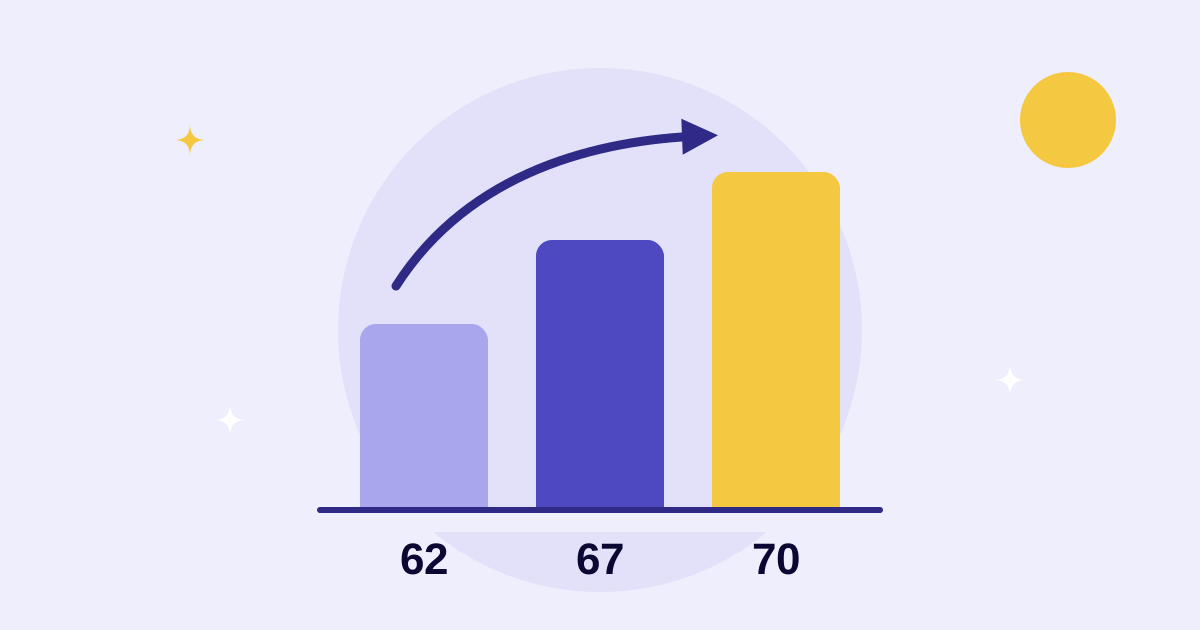
You can start Social Security retirement benefits at any point between 62 and 70. Each month you wait makes the monthly check bigger, up to age 70. And the choice sticks. Beyond a one-time option to withdraw your application within the first 12 months, which means paying back everything you received, the amount you lock in is the amount you keep, plus yearly cost-of-living raises.
Full retirement age is the reference point
Social Security works out a base amount called your primary insurance amount, or PIA. That's the monthly benefit you'd get by claiming at your full retirement age, which is 67 for anyone born in 1960 or later.
Claim before 67 and your check is permanently reduced. Claim after 67 and it's permanently increased, by 8% for each full year you wait, until 70. After 70 there's no further increase, so there's no reason to wait longer.
A worked example
Take someone born in 1964 whose PIA is $2,000 a month. Here's what each claiming age would pay, before any cost-of-living raises:
| Start benefits at | Share of PIA | Monthly benefit |
|---|---|---|
| 62 | 70% | $1,400 |
| 65 | 86.7% | $1,733 |
| 67 | 100% | $2,000 |
| 70 | 124% | $2,480 |
Starting at 70 instead of 62 is worth $1,080 more a month, or almost $13,000 a year, for life.
Breakeven ages
Claiming early gets you more checks. Waiting gets you bigger ones. The breakeven age is the point where the bigger checks catch up in total.
| Comparing | Waiting catches up at about |
|---|---|
| 62 vs. 67 | Age 78 and 8 months |
| 67 vs. 70 | Age 82 and 6 months |
| 62 vs. 70 | Age 80 and 5 months |
These are simplified. They leave out taxes, cost-of-living raises (which nudge the math a little toward waiting) and any return you'd earn by investing early checks (which nudges it the other way).
What the table is really asking is how long you expect to live. If your health is poor, or most of your family didn't make it to their late 70s, claiming earlier is reasonable. If you're healthy and your parents lived into their 90s, waiting works like insurance against outliving your savings.
If you're married, think about the survivor
This part gets less attention than it deserves. When one spouse dies, the survivor keeps the larger of the two benefits. A surviving spouse at full retirement age or older generally gets 100% of the deceased worker's benefit.
So when the higher earner waits until 70, that larger check can keep paying until the second spouse dies, too. For couples, the higher earner's claiming age affects two lifetimes, not one.
Working while you collect early
If you claim before full retirement age and keep working, the earnings test may hold back part of your benefits. For 2027, Social Security withholds $1 for every $2 you earn above $25,560. In the calendar year you reach full retirement age, the limit rises to $67,920, the withholding drops to $1 for every $3, and only the earnings before the month you reach that age count.
For example, someone who's 63 in 2027 and earns $40,000 would be $14,440 over the limit, so about $7,220 of benefits would be held back that year.
Withheld benefits aren't lost for good. When you reach full retirement age, Social Security recalculates your monthly amount to credit you for the months it withheld. And from that point on, there's no earnings limit at all.
Two more things to know
- Medicare starts at 65, whenever you claim Social Security. If you aren't collecting benefits yet, you have to sign up for Medicare yourself, during a seven-month window that starts three months before the month you turn 65. Social Security warns that if you don't, your coverage may be delayed and cost more.
- The 2027 cost-of-living adjustment is 3.6%, starting with January 2027 payments. Social Security estimates the average retired worker's monthly benefit will go from $2,095 to $2,170.
Before you decide, sign in to your my Social Security account at ssa.gov. It shows your own estimated benefit at each age, based on your actual earnings record, and that beats any example, including ours.